Low water pressure is one of the most common complaints in UAE villas. Rainfall showers on the upper floor barely run, the pressure drops when someone opens the kitchen tap, or the washing machine takes ages to fill. In many cases the building relies on a roof tank and gravity alone, or on a booster pump that is too small, poorly set up or worn out.
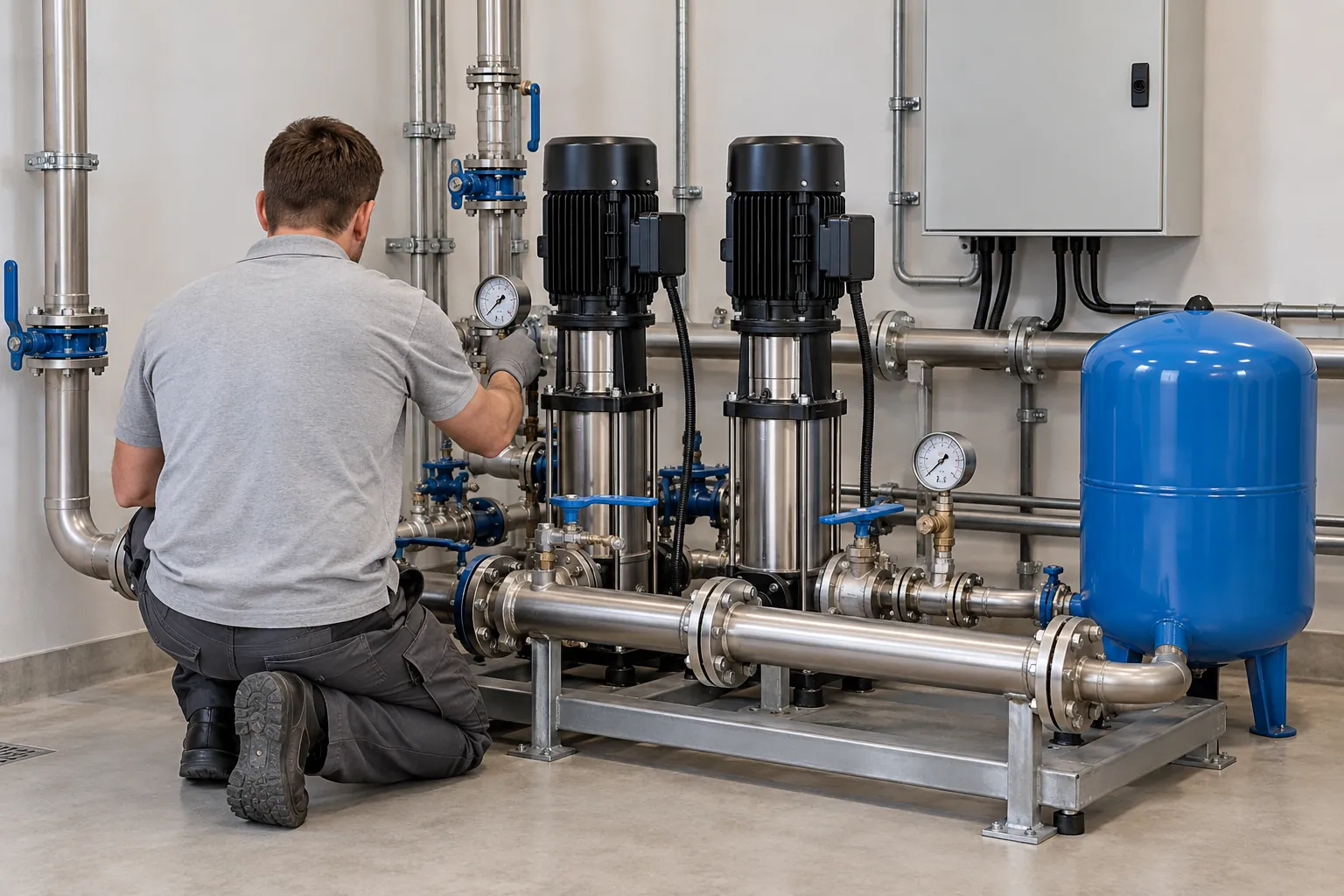
We supply and install booster pumps and pressure systems for villas, apartments and commercial buildings in Dubai and across all seven emirates. We start by finding out why pressure is low, because a new pump is not always the answer.
Why water pressure is low
Before choosing a booster pump, it helps to rule out other causes:
- Gravity supply only. A roof tank gives very little pressure to the floor directly below it. Top-floor bathrooms are the worst affected.
- An existing booster that is failing. Worn impellers, a failed pressure vessel or incorrect settings reduce pressure. These are often repairable; see water pump repair.
- Blocked filters and strainers on the pump inlet or at the fixtures.
- Scaled mixers and shower heads, which restrict flow at the outlet even when pressure in the pipes is fine.
- Undersized or corroded pipework, particularly old galvanised pipes.
- Filtration equipment that has not been serviced. Clogged whole-house filters cause a noticeable pressure drop. See whole-house water filtration.
- Partly closed valves after recent plumbing work.
If pressure is poor at only one outlet, the problem is usually local. If it is poor throughout, the supply or pump is the likely cause.
Types of booster systems
Fixed-speed pump with pressure vessel
The traditional arrangement. A pump runs at full speed whenever pressure falls below a set point and stops when it reaches the upper set point. A pressure vessel stores a small volume of water under pressure, so the pump does not start every time a tap opens. Simple and economical, but pressure rises and falls between the two set points, and the pump is noisy when it runs.
Variable-speed (constant pressure) pump
A variable-speed drive (VFD) adjusts the motor speed to hold a steady pressure, whether one tap or five are open. Pressure feels constant at the shower, starts and stops are soft, energy use falls at low demand, and the system is usually quieter. These systems cost more but suit villas with high-specification showers and many bathrooms.
Multi-pump and duty/standby sets
Larger villas and buildings use two or more pumps on a common frame. They can share the load at peak demand and rotate duty to even out wear, and if one pump fails, the other keeps water flowing. This is the standard approach for apartment buildings and commercial properties.
How a pressure vessel works
A pressure vessel is a steel tank with a rubber diaphragm or bladder inside. Water is on one side, compressed air on the other. As the pump runs, water enters and compresses the air. When a tap opens, the compressed air pushes water out until pressure drops to the point where the pump restarts.


For this to work, the air side must be charged to the correct pressure, usually set slightly below the pump’s start pressure. If the air charge leaks away, or the diaphragm bursts, the vessel fills with water and the pump starts and stops rapidly. That short cycling is one of the most common booster faults, and it wears out pumps and pressure switches quickly. Checking the pre-charge is part of routine pump maintenance.
Sizing a booster pump
The right booster depends on:
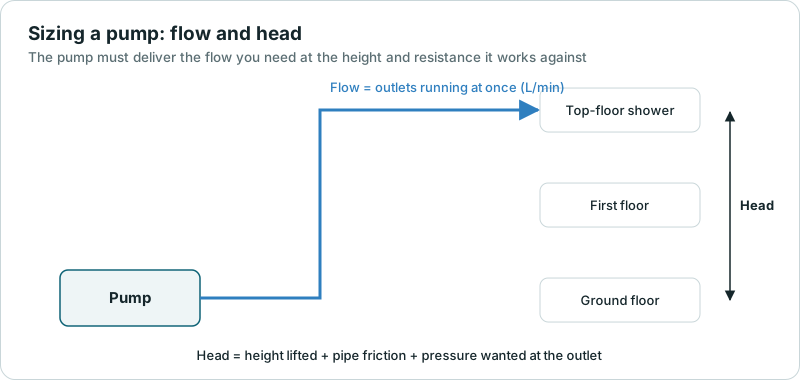
- Simultaneous demand — how many showers, taps and appliances may run at once
- Fixture requirements — rainfall showers and body jets need more flow than standard heads
- Height — the number of floors and the highest outlet
- Supply — whether the pump draws from a roof tank or a ground tank
- Target pressure — comfortable pressure at the outlets without stressing mixers, hoses and water heaters
An oversized pump is not better. It cycles more, raises pressure beyond what fittings are designed for, and can cause water hammer and leaks. We calculate demand and select a pump whose performance curve matches it.
Installing a booster pump
A good booster installation includes:
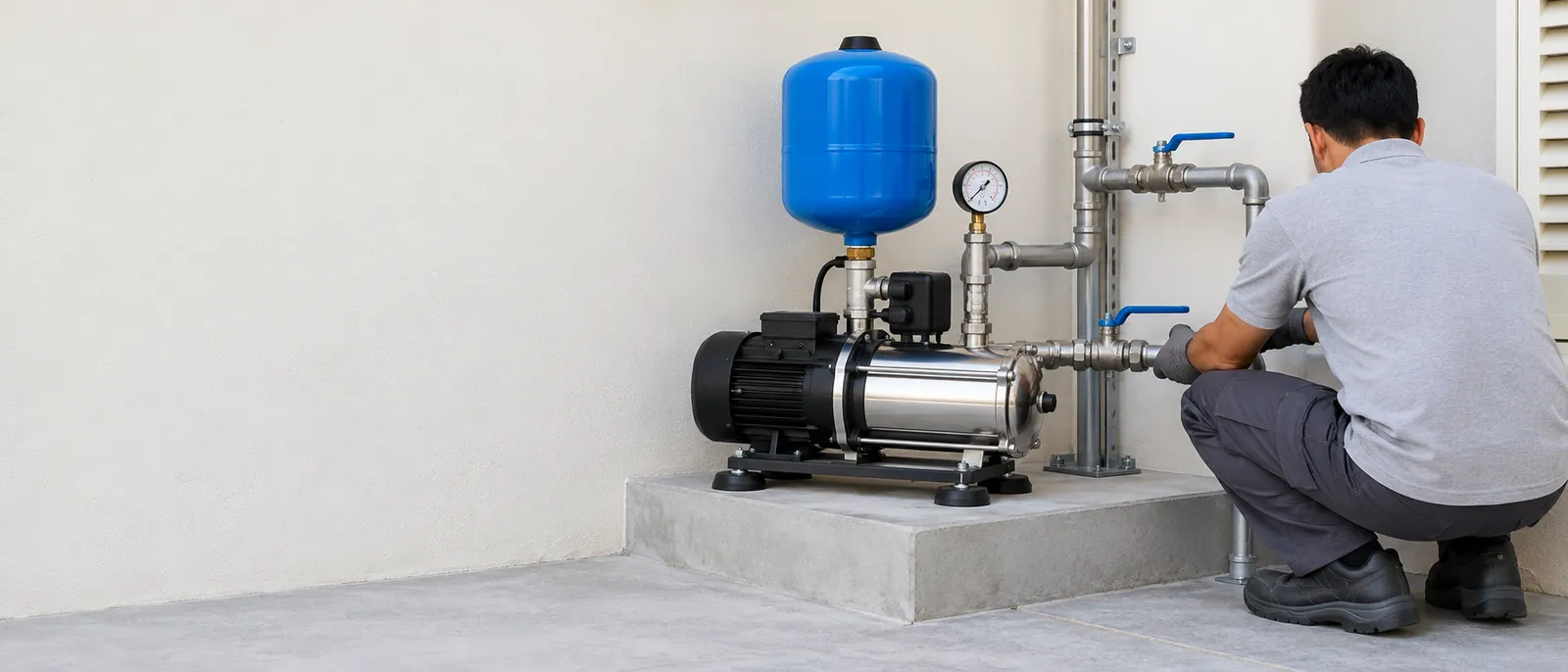
- a level base with anti-vibration mounts and flexible connectors
- isolation valves, a non-return valve and an inlet strainer
- a correctly sized and pre-charged pressure vessel
- dry-run protection linked to the supply tank level
- an electrical supply with isolator and overload protection; if the circuit needs upgrading, our electrical services team can help
- a bypass, where practical, so water still flows by gravity if the pump is out of service
Commissioning includes setting pressures, testing at low and high demand, and checking noise and vibration. Our work carries a 1-month workmanship warranty, and new parts carry the manufacturer’s warranty, subject to the manufacturer’s terms. Where applicable, we register the manufacturer’s warranty for you after installation.
Keeping booster pumps quiet
Booster noise is a common complaint, especially in villas where the pump room sits beside a bedroom or a neighbour’s wall. Noise comes from the motor, from vibration transmitted through the base and pipes, and from frequent starting. Anti-vibration mounts, flexible pipe connectors, a correctly charged vessel, and a variable-speed pump all reduce it significantly. Relocating the pump is sometimes worthwhile during an upgrade.
What affects the cost
The cost depends on the pump type and brand, fixed or variable speed, single or multi-pump set, vessel size, pipework changes, electrical work and access. Surveys are free within Dubai. Outside Dubai, the AED 250 site-visit charge applies and is deducted from the job if you go ahead.
Booster pumps across the UAE
We supply and install booster pumps in Dubai, Abu Dhabi, Sharjah, Ajman, Ras Al Khaimah, Fujairah and Umm Al Quwain. Our office is in Al Khabaisi, Dubai. Visits within Dubai are free; outside Dubai a AED 250 site-visit charge applies, which is fully deducted from the service cost if you go ahead. All visits are scheduled in advance.
Booster pumps for apartment buildings
Residential buildings usually have central booster sets in a basement or ground-floor pump room, serving every apartment through risers. These are normally multi-pump sets with variable-speed control and duty rotation, sized for the building’s peak demand, and they are the responsibility of building management rather than individual residents.
If you live in an apartment and pressure is poor, the cause may be inside the apartment (scaled mixers, blocked filters, a faulty pressure-reducing valve) or in the building system. We can check the apartment side and tell you whether the problem appears to come from the building supply. For building owners and facility managers, we supply, install and maintain central booster sets.
Request a quote for a booster pump
Tell us what you need and send photos on WhatsApp if you can. Site visits within Dubai are free, and every price is confirmed before work starts.
Frequently asked questions
Will a booster pump fix weak pressure in my rainfall shower?
If the cause is low supply pressure, yes. If the shower head or mixer is scaled or restrictive, that needs addressing too.
Fixed speed or variable speed?
For a small home with modest demand, a fixed-speed pump and vessel works well. For larger villas or high-flow showers, variable speed gives steadier, quieter pressure.
Why does my booster pump switch on when no taps are open?
Usually a leak somewhere in the system, a dripping cistern, or a vessel that has lost its air charge.
Can the booster pump go on the roof?
It can, if it is shaded, ventilated and accessible. Ground-level pump rooms are usually easier to maintain and quieter for occupants on the top floor.
Can a booster pump damage my plumbing?
Correctly set pressure will not. Excessive pressure from an oversized or badly set pump can stress hoses, mixers and water heaters, which is why sizing and settings matter.
Related services
For faults with an existing booster, see water pump repair. Keep the system reliable with water pump maintenance or an annual maintenance contract. For other pump types, see water pump supply and installation.