A reverse osmosis (RO) system turns tap water into clean-tasting drinking and cooking water at your kitchen sink. For many UAE households, it replaces the routine of ordering, storing and lifting bottled water, and it takes up little more space than a waste bin under the sink.
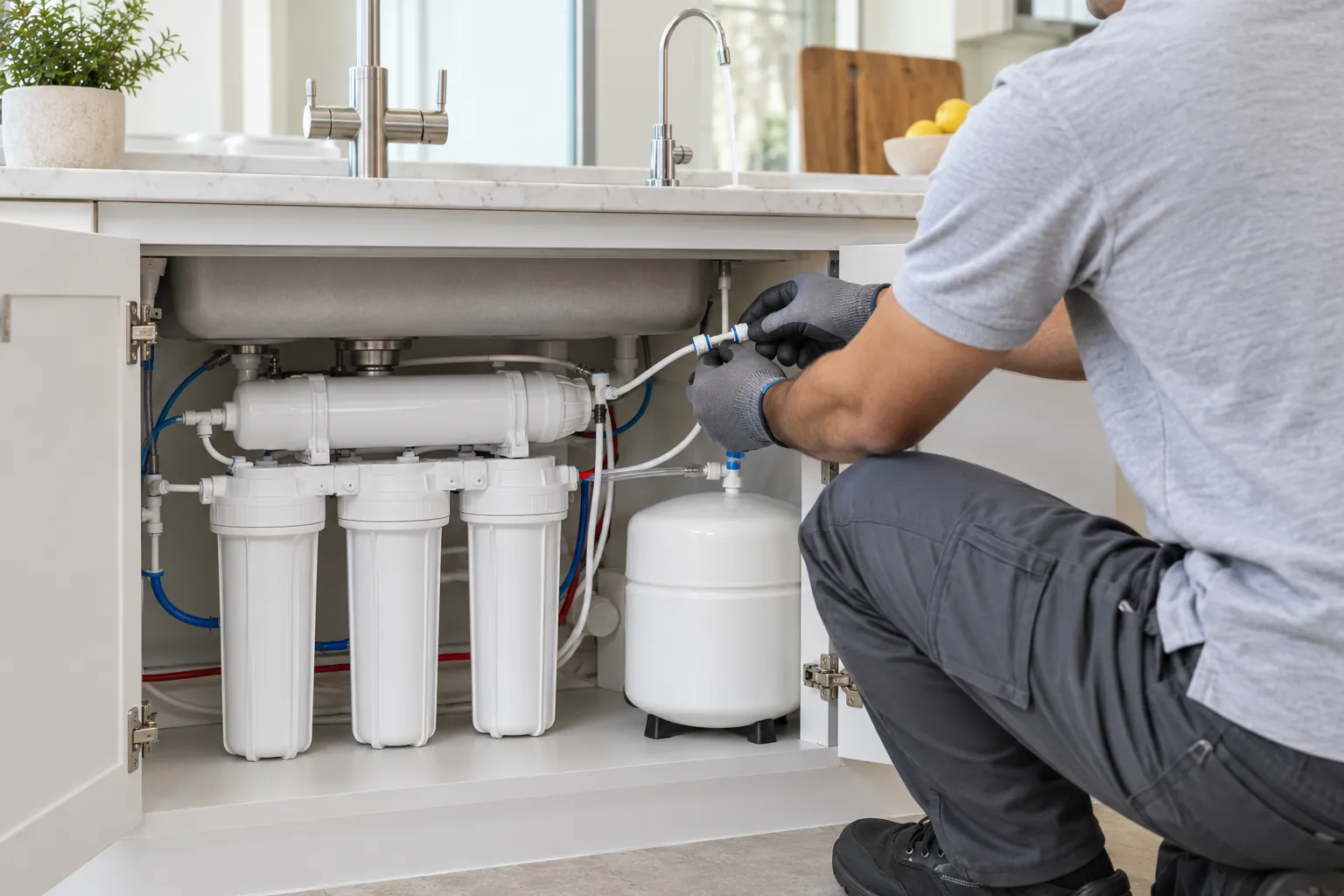
We supply, install and service RO systems for apartments, villas and offices in Dubai and across all seven emirates, and we replace filters and membranes on existing units, including ones we did not install.
How reverse osmosis works
At the heart of every RO system is a semi-permeable membrane. Water is pushed against it under pressure. Water molecules pass through, while most dissolved salts and many other substances are held back and flushed away to the drain.
The water that passes through, called permeate, goes to your drinking tap. The water carrying the rejected substances, called concentrate or reject water, goes to the drain. Before and after the membrane, conventional filters protect it and polish the taste of the final water.
Because the membrane is so fine, RO produces water slowly compared with an ordinary tap. That is why it is used for drinking and cooking rather than for the whole house.
The stages of a typical RO system
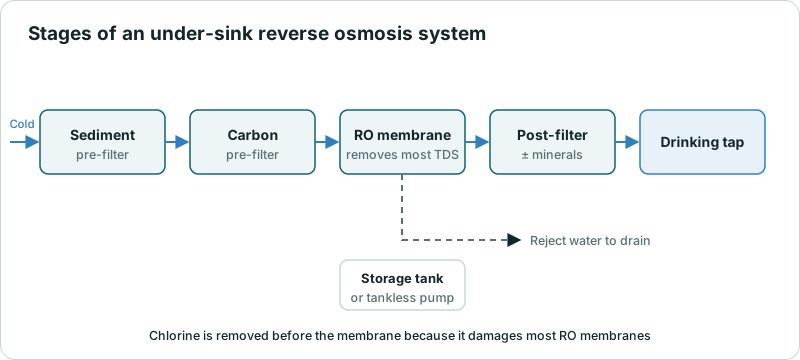
Sediment pre-filter
Catches sand, rust and particles that would otherwise clog the following filters and the membrane.
Carbon pre-filter
Removes chlorine, which would damage most RO membranes, and reduces many taste and odour compounds.
RO membrane
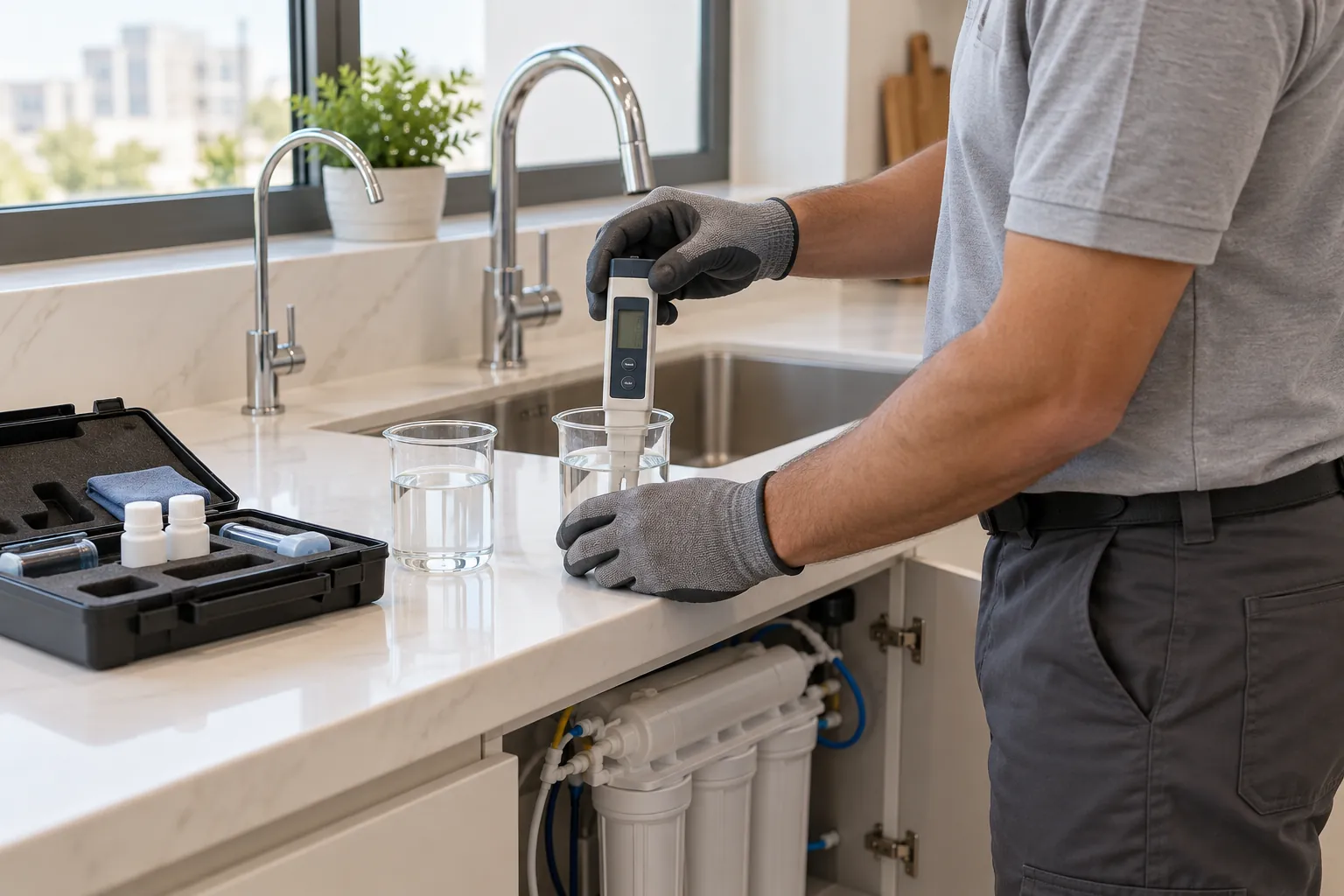
The main treatment stage, removing most dissolved solids. A TDS (total dissolved solids) reading before and after the membrane shows how well it is working.
Post-filter and optional mineral stage
A final carbon “polishing” filter improves taste, especially in systems with a storage tank. Some systems add a remineralisation cartridge that returns a small amount of calcium and magnesium for taste.
Systems differ in how these stages are packaged: separate cartridges in housings, or compact quick-change modules.
Tank or tankless?
Systems with a storage tank fill a small pressurised tank slowly, so you can draw a jug of water quickly. They are simple and widely available, but the tank takes space under the sink, and water sitting in the tank benefits from a post-filter.
Tankless (direct-flow) systems use higher-output membranes and usually a built-in pump to produce water on demand. They are compact and avoid stored water, but they cost more, need an electrical socket, and flow at the tap is slower than from a full tank.
Which suits you depends on space under the sink, whether there is a socket, and how much water the household draws at once.
What to know before choosing RO
Reject water. Every RO system sends some water to the drain. How much depends on the membrane, the system design and your water pressure. Modern designs waste less than older ones, and reject water can sometimes be redirected for uses such as cleaning, depending on the installation.
Minerals. RO removes most minerals along with other dissolved solids. Some people prefer the taste of RO water with a remineralisation stage. This is a matter of taste and preference; we do not make health claims either way.
Water pressure. RO needs adequate pressure to work efficiently. In buildings with low pressure, output drops and more water goes to the drain. A small booster pump on the RO unit, or improving the building’s supply with a booster pump, solves this.
Space and connections. An under-sink system needs room for the filters and tank, a cold water connection, a drain connection, and space for a separate drinking tap on the sink or worktop. Tankless units also need a socket.
Maintenance. RO only works if filters and membranes are changed on schedule. Factor ongoing filter costs into your decision.
RO is not whole-house treatment. For sediment, chlorine or scale at every outlet, see whole-house water filtration.
Installation
A typical under-sink installation includes:
- Checking water pressure and the space under the sink
- Fitting a feed valve on the cold supply
- Mounting the filter unit and tank
- Fitting the drain connection with an air-gap or non-return arrangement to prevent backflow
- Drilling the sink or worktop for the drinking tap where needed
- Flushing new filters and the membrane, as the manufacturer specifies
- Checking for leaks and measuring TDS before and after
A standard installation is usually completed in a single visit. Our work carries a 1-month workmanship warranty, and new parts carry the manufacturer’s warranty, subject to the manufacturer’s terms.
RO filter replacement
Filter stages wear at different rates. As a general guide:

- Sediment and carbon pre-filters are typically changed every 6 to 12 months
- The membrane usually lasts longer, often two to three years, if the pre-filters are changed on time
- Post-filters and mineral cartridges are typically changed about once a year
Your water, usage and the manufacturer’s recommendations set the actual interval. Signs that a change is overdue include slower flow, a change in taste, or a rising TDS reading at the tap.
We replace filters and membranes on most common RO systems. Send a photo of your unit and filter housings so we bring the right parts. For scheduled replacement across several systems, see filter replacement and maintenance.
What affects the cost
The cost depends on the system type (tank or tankless), the number of stages, any remineralisation or pump, worktop drilling, and the brand. Ongoing costs depend on filter replacement intervals.
RO systems across the UAE
We supply, install and service RO systems in Dubai, Abu Dhabi, Sharjah, Ajman, Ras Al Khaimah, Fujairah and Umm Al Quwain. Our office is in Al Khabaisi, Dubai. Visits within Dubai are free; outside Dubai a AED 250 site-visit charge applies, which is fully deducted from the service cost if you go ahead. All visits are scheduled in advance.
Request a quote for an RO system
Tell us what you need and send photos on WhatsApp if you can. Site visits within Dubai are free, and every price is confirmed before work starts.
Frequently asked questions
Can I install an RO system in a rented apartment?
Usually, yes, with the landlord’s permission. Under-sink systems can be removed when you move, leaving only the tap hole to fill.
Why has my RO water flow slowed down?
Most often, clogged pre-filters or an ageing membrane. Low supply pressure and a tank that has lost its air charge are other causes.
Why does my RO water taste odd?
An exhausted post-filter, a tank that has not been used for a while, or a new filter that was not flushed properly are common causes.
Can I connect RO water to my fridge?
Often, yes, with an extra line to the fridge’s water inlet. Check the fridge manufacturer’s requirements first.
How do I know if my membrane is still working?
A TDS meter reading at the tap compared with tap water shows how much the membrane is removing. A rising reading means it is time for a check.
Do you service RO units bought online?
Yes, if parts are available for the model. A photo of the unit and its labels helps us confirm.
Does an RO system need electricity?
Systems with a storage tank usually run on water pressure alone. Tankless units and systems with a booster pump need a socket under the sink.
How much space does an under-sink RO system need?
Most tank systems need room for a filter unit and a tank roughly the size of a large kettle. Tankless units are slimmer. We check the cabinet before recommending a model.
Should I keep an RO system running while I am away?
If you travel for several weeks, flush the system on your return by drawing off and discarding the first tank of water. For long absences, ask us whether a filter change is due before you come back.
Related services
Compare all our water filtration systems, or treat water for the whole home with whole-house filtration. Filter changes can be included in an annual maintenance contract.