Hard water leaves its mark everywhere: white crust on taps and shower heads, cloudy glass screens that never come clean, scale inside kettles, and heating elements that fail long before they should. A water softener removes the minerals that cause it, protecting fixtures, water heaters and appliances throughout the home.
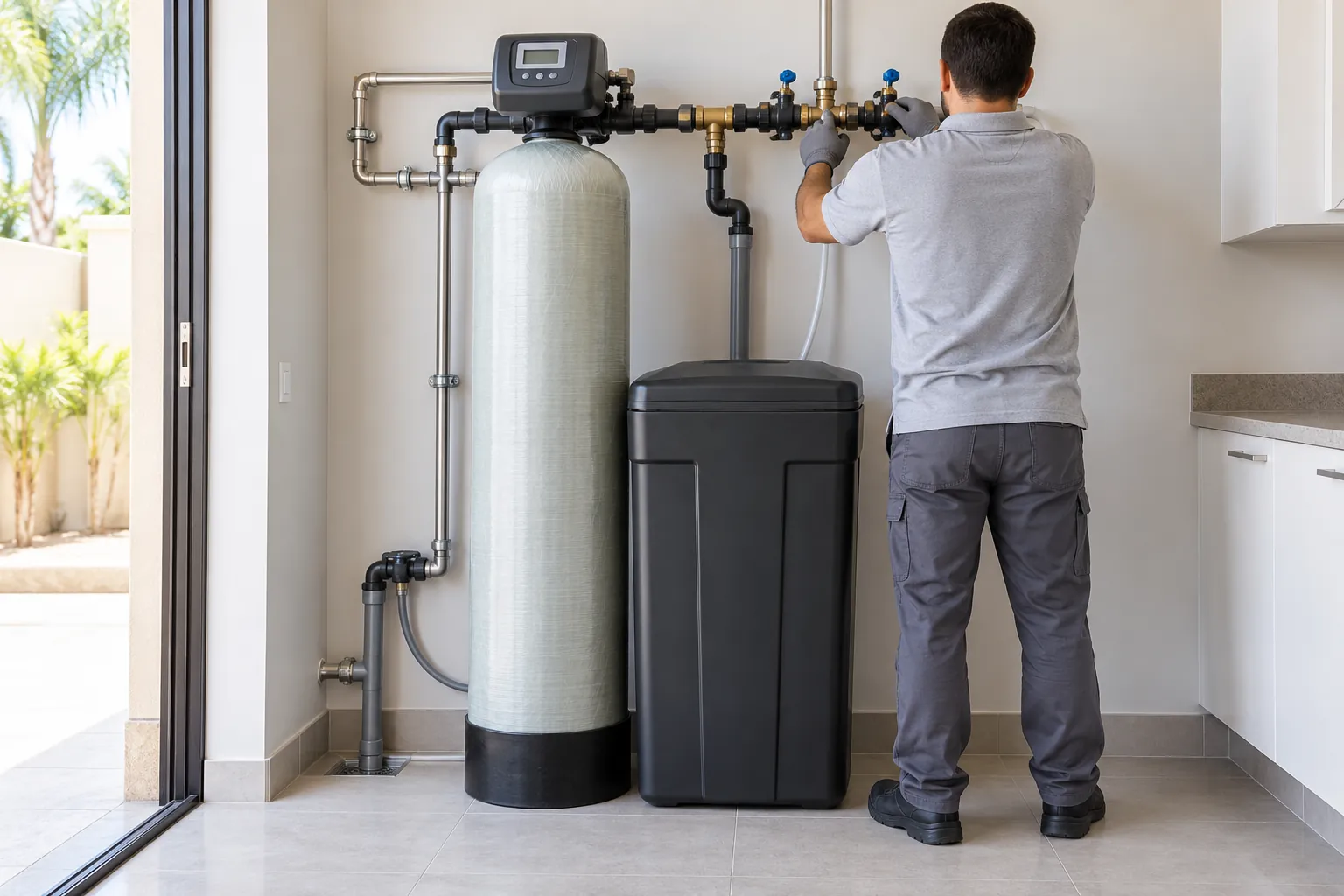
We test water hardness, then supply, install and service water softeners for villas and homes in Dubai and across all seven emirates. If your water does not need softening, we will tell you.
What hard water is
Hardness is mainly the amount of dissolved calcium and magnesium in water. It is usually expressed in milligrams per litre as calcium carbonate (mg/L as CaCO₃), or in grains per gallon. When hard water is heated or evaporates, those minerals come out of solution as limescale.
Hardness varies with the water source and what happens to it before it reaches your tap, including storage in tanks. Two properties in the same area can see different results, which is why testing your own water matters.
Signs of hard water
- White or chalky deposits on taps, shower heads and around drains
- Glass shower screens that look cloudy soon after cleaning
- Scale inside kettles and on heating elements
- Shower heads and aerators that clog and lose flow
- Water heater elements that fail repeatedly, or a heater that makes popping sounds
- Spots on dishes and glassware after washing
Scale on a water heater element insulates it, so it runs hotter and fails sooner. If your heater keeps tripping or losing efficiency, see water heater repair.
Do you actually need a softener?
Not always. Some white marks come from dissolved solids that a softener will not remove, or from evaporation of very small amounts of minerals. A softener makes sense when a hardness test shows levels high enough to cause the scale you are seeing, and when you want protection for the whole home rather than one fixture.
If hardness is low, regular descaling of fixtures and heaters may be all you need. If your main concern is drinking water taste, an RO system at the kitchen tap is the better choice.
How a water softener works
Ion exchange
A softener contains a tank of resin beads that carry sodium ions. As hard water passes through, the resin captures calcium and magnesium and releases sodium in their place. The water leaving the softener no longer forms scale.
Regeneration
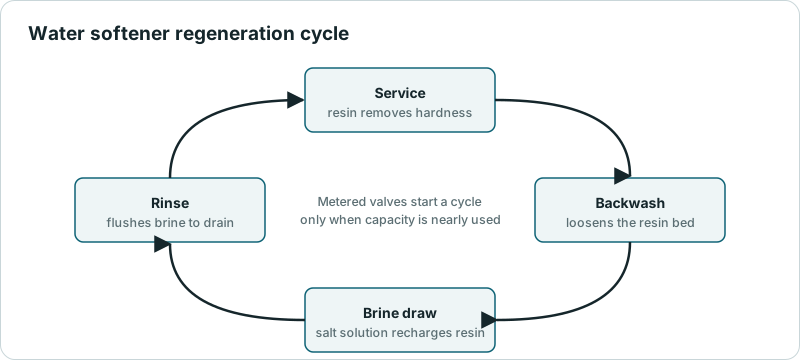
Over time, the resin fills with hardness minerals and must be recharged. During regeneration, the control valve backwashes the resin bed, draws strong brine from the salt tank through it, then rinses it. The hardness minerals and spent brine go to the drain, and the resin is ready again.
How the softener decides when to regenerate matters:
- Time-clock control regenerates on a fixed schedule, regardless of use. It is simple, but it can waste salt and water when use is low.
- Metered (volumetric) control measures water use and regenerates only when the resin’s capacity is nearly used. It is generally more efficient.
Sizing a softener
A softener is sized from three things:
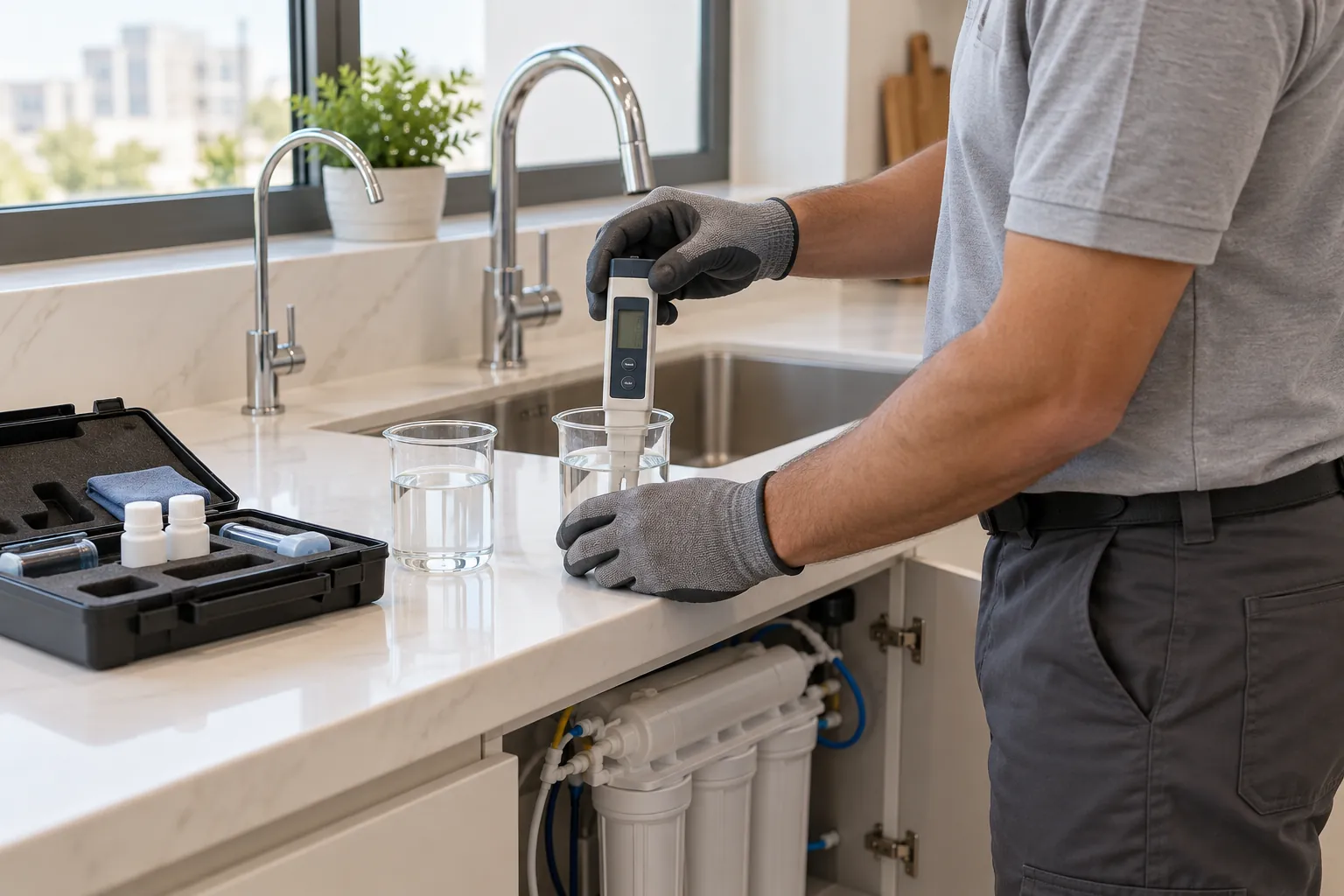
- Hardness — how much has to be removed from each litre
- Daily water use — based on the number of occupants and bathrooms
- Peak flow rate — so pressure does not drop when several outlets run at once
Too small a unit regenerates very often and may let hard water through at peak flow. Too large a unit costs more and, on time-clock control, wastes salt. We size each softener from your test and your home.
Installation
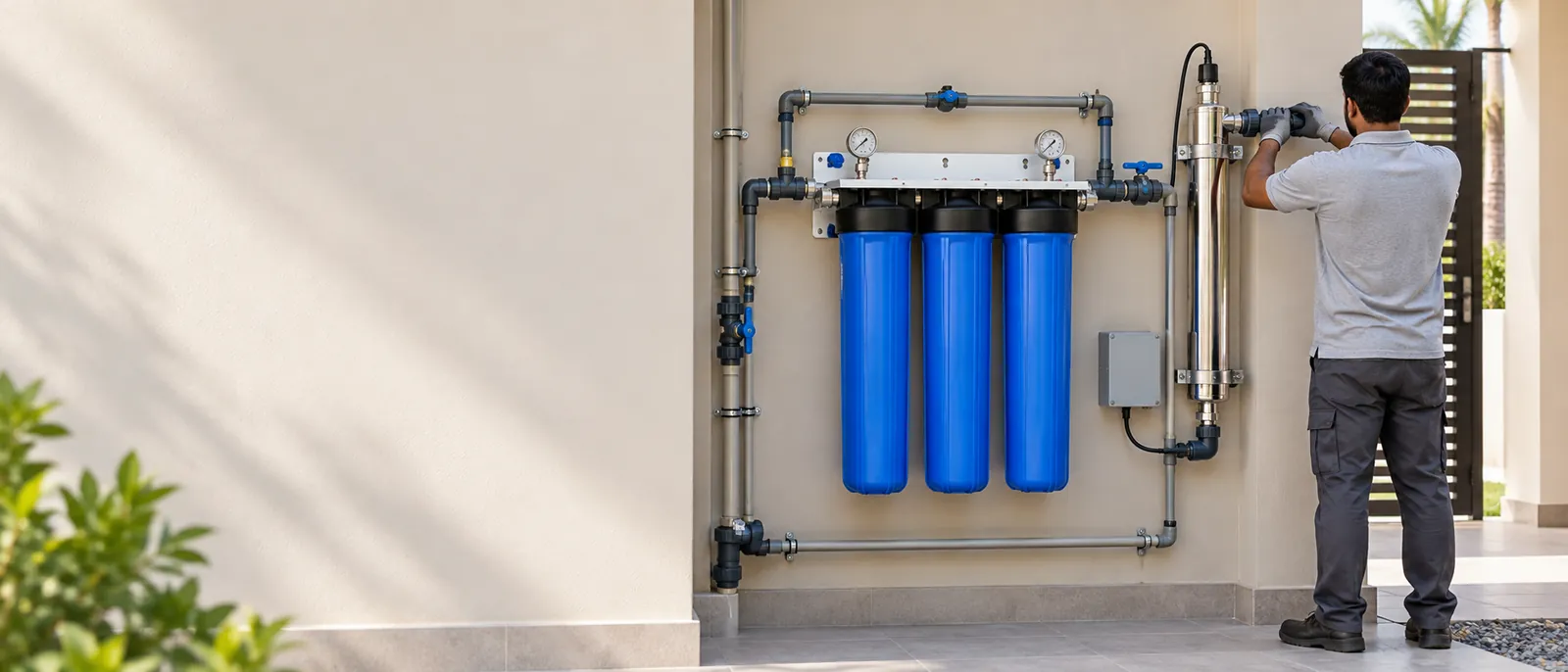
Softeners are normally installed on the main supply after the tank and pump, alongside or within a whole-house filtration system. A proper installation includes:
- a bypass valve, so water can still flow during servicing
- a drain connection for regeneration water, with an air gap to prevent backflow
- an overflow on the salt tank
- a power supply for the control valve
- programming for your hardness and household
- often, a hard-water outlet left for garden irrigation, where softening is unnecessary
We test the treated water after installation to confirm it is soft. Our work carries a 1-month workmanship warranty, and new parts carry the manufacturer’s warranty, subject to the manufacturer’s terms.
Softener servicing and repair
A softener needs little attention, but it does need some. We service and repair most common softeners, including units we did not install.
Routine servicing includes:
- checking salt level and breaking up salt bridges, hard crusts that form in the brine tank and stop brine being drawn
- cleaning the brine tank and injector
- checking the control valve settings, clock and regeneration cycle
- testing treated water hardness
- inspecting seals and the bypass valve
Common faults include a softener that has stopped regenerating, uses far too much or too little salt, lets hard water through, or leaks at the valve. Causes range from a salt bridge or blocked injector to a failed valve motor or worn seals. Resin also ages and eventually needs replacing.
Softeners and drinking water
Softening adds a small amount of sodium to the water in exchange for the hardness it removes. The amount depends on how hard the water was. Many households keep one unsoftened cold tap for drinking or fit an RO system in the kitchen, which removes most dissolved solids, including sodium. See reverse osmosis systems.
Salt-free conditioners
“Salt-free” conditioners work differently: they change how minerals behave so they are less likely to stick as scale, but they do not remove hardness. They need no salt and no drain, but results vary with water conditions and they will not give the soft feel of truly softened water. We can explain both options after testing your water.
What affects the cost and where we work
The cost depends on the softener size, control type, installation complexity, and whether it is combined with other filtration. We install and service softeners in Dubai, Abu Dhabi, Sharjah, Ajman, Ras Al Khaimah, Fujairah and Umm Al Quwain. Our office is in Al Khabaisi, Dubai. Visits within Dubai are free; outside Dubai a AED 250 site-visit charge applies, which is fully deducted from the service cost if you go ahead. All visits are scheduled in advance.
Request a quote for a water softener
Tell us what you need and send photos on WhatsApp if you can. Site visits within Dubai are free, and every price is confirmed before work starts.
Frequently asked questions
How often do I need to add salt?
It depends on hardness, water use and tank size. Many households check monthly and top up as needed.
What kind of salt should I use?
Use salt made for water softeners, usually tablets or pellets, as specified by the manufacturer. Table salt and rock salt can cause problems.
Will a softener lower my water pressure?
A correctly sized softener causes only a small pressure drop. An undersized unit can restrict flow noticeably.
Can a softener be installed in an apartment?
If there is space on the apartment’s supply, a drain and power, and the building allows it, yes. Compact units exist, but many apartments use point-of-use options instead.
Why is my softener not working?
Check the salt level first. If there is salt, a salt bridge, a blocked injector or a control valve fault is likely, and it needs servicing.
How long does a softener last?
With servicing, the control valve and tanks last many years. The resin bed gradually loses capacity and eventually needs replacing, sooner if the water contains chlorine or iron.
Can a softener go outdoors?
It is better indoors or in a shaded, ventilated plant area. Direct sun and high temperatures can damage tanks, the control valve and electronics.
Related services
Compare all our water filtration systems, or combine softening with sediment and carbon stages in whole-house filtration. Softener servicing can be included in an annual maintenance contract.